Hiring someone is the start of a relationship, not the end of a process. The offer gets signed, and then a long list of things has to happen: a laptop has to arrive, accounts have to exist, training has to be assigned, benefits have to be chosen, and, a few months in, someone has to sit down and talk about how it's going. In most companies each of those steps lives in a different tool, owned by a different team, and the new hire is the only person who sees all of them.
This article follows that first year as it runs in Syott. Onboarding, training, benefits, performance reviews and surveys are separate parts of the product, but they work from the same employee profile. What happens in one is there for the next, so nobody has to copy a start date, a role or a team from one system into another.
The scenes below come from our product tours and use example people: Lena, a new engineer, and a few of her colleagues. Each one plays as you scroll to it.
Before day one
The first year starts before the first day. The moment an offer is accepted, the new hire's onboarding journey begins. Journeys are built by role, department or location, so an engineer in Lisbon gets the steps an engineer in Lisbon needs: paperwork, training, tool access and team introductions, each with an owner.
Some of that work belongs to the new hire. Tax forms, emergency contacts, direct deposit details and policy acknowledgments can all be completed before day one, so people arrive ready to work rather than buried in paperwork.
The rest belongs to the company, and this is where things usually slip. In Syott, accepting the offer is what sets it off. Accounts are provisioned, equipment is requested and software licenses are assigned, and IT and facilities get a heads-up without HR having to chase anyone.
Candidates › Lena Fischer

Lena FischerProduct Designer · Referral
Offer- Applied
- Screen
- Interview
- Offer
- Hired
Score
4.6Strong yes


 3 scorecards
Offers
Product Designer offerDraftPending approval
€62,000 · Starts 1 Feb 2027Terms
- Total (annualised)
- €62,000
- Start date
- 1 Feb 2027
- Expires
- 4 Dec 2026
- Template
- Standard offer
Approvals
- 1 Hiring managerBy Priya Shah PendingApproved
- 2 HR business partnerBy Ana Moreira PendingApproved
- 3 FinanceBy Tom Lang PendingApproved
HR › Pre-hires › Add pre-hire
Welcome to Syott — set up your accountSyott · lena.fischer@example.com
 Syott
Welcome to Syott
Hi Lena,
Your onboarding is ready. Use the link below to set up your account and complete your personal details, documents, and policies.
Set up your account This link expires in 7 days.SyottEmployee Onboarding
About you · Step 1 of 15Admin · Step 5 of 15Workplace · Step 9 of 15Legal & account · Step 13 of 15
Personal information
Check your details and fill in anything missing.
Managed by HR
- Role
- Product Designer
- Department
- Design
- Start date
- 1 Feb 2027
- Employment
- Full-time
- Reports to
- Priya Shah
- Office
- Lisbon
Documents to sign
Read and sign each document before your first day.
- Offer letter & employment agreementRequired
- Non-Disclosure AgreementRequired
- Intellectual Property AssignmentRequired
- Non-Compete & Non-Solicit AgreementRequired
- Equipment Loan AgreementRequired
4 of 5 signed5 of 5 signed
- Offer letter & employment agreement Signed
- Non-Disclosure Agreement Signed
- Intellectual Property Assignment Signed
- Non-Compete & Non-Solicit Agreement Signed
- Equipment Loan Agreement RequiredSigned
Equipment Loan Agreement
Type your full legal name to signLena Fischer
Sign documentSigned by Lena FischerSet up your account
Usernamelena.fischer
You'll sign in with
Passwordless magic code sent to your email
You're all set, Lena!
Onboarding is complete. Check your email for the magic-code sign-in link and jump into Syott OS.
- Check your email for access instructions
- Sign in to Syott OS with your new account
- Your manager will be in touch to schedule your first day
HR › Onboarding
Create a pre-hire, run onboarding, then activate them into a worker.Lena FischerProduct Designer · Design
- Created
- Invite sent
- In progress
- Completed
- Activated
- Start date
- 1 Feb 2027
- Employment type
- Full-time
Activate → create worker Activating... Worker created
Good morning, Lena
Here's what's happening across your workspace.






Pre-hire createdLena Fischer, from the signed offer
Lena Fischer
CandidateOffer approvedOffer signedPre-hireInvite sentIn progressSignedCompletedActivatedWorker
In the scene above, the offer is accepted and the requests go out on their own: a laptop, email and sign-on and software licenses from IT, a desk and badge from facilities. By the time Lena reaches that point in her journey, what she needs is waiting for her.
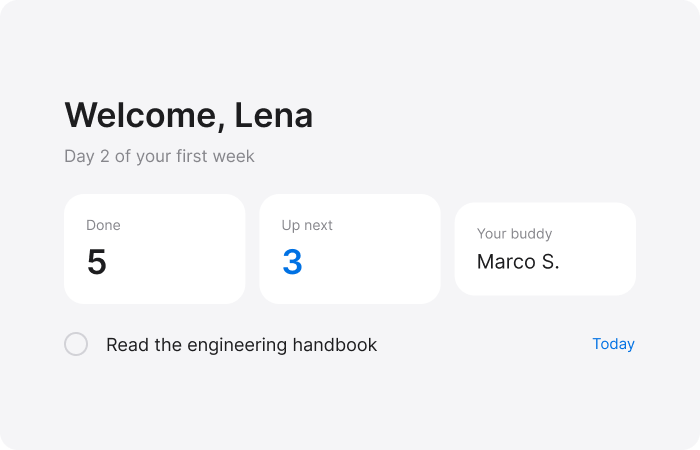
Once she starts, she sees her own onboarding as a step-by-step dashboard: what's done, what's next and who to reach out to. Across every new hire, the people team can measure completion rates, time to productivity and satisfaction, and see where people get stuck.
Learning the job
Onboarding gets someone through the door. Training is how they get good at the job, and it rarely stops after the first week.
In Syott, learning paths are built for roles and teams, from compliance basics everyone needs to the skills specific to each job. They're assigned automatically when someone joins or moves. Lena doesn't have to find her training or wait for someone to send it: joining Engineering is enough.
Learning › Learning paths
Learning pathsCourses grouped by role, assigned when someone joins or moves.
New path- 1. Everyone Path · 3 courses Required
- 2. Dev setup Course · e-Learning · 30 min Required
- 3. Code review Course · e-Learning · 45 min Required
- 4. How we ship Course · Blended · 45 min
- 5. First release Milestone · With a mentor
- 6. On-call basics Course · Instructor-led · 2 h
Assigned automatically
Lena joins EngineeringLearning path assigned automatically
Engineering
Tom Lang moves to Customer successNew path assigned
EngineeringCustomer success
Learning › My enrollments
LenaEngineering path · assigned on day one
CourseStatusDueScore
- Everyone3 courses Completed — 96
- Dev setupe-Learning In progressCompleted — —88
- Code reviewe-Learning AssignedIn progress Friday —
- How we shipBlended Assigned In 2 weeks —
- On-call basicsInstructor-led Assigned In 4 weeks —
Code review · Due Friday · reminder sent
Learning › Enrollments
Your teamEngineering path
Assign courseCompletion
68%Due this week
2Overdue
1PersonProgressDueStatus
-
Lena
4/7
Friday
In progress
-
Priya Shah
7/7
—
Completed
-
 Nils Berg
6/7
In 2 weeks
In progress
-
Alex Ferri
2/7
3 days ago
Overdue
Learning › Certifications
CertificationsExpiry dates on each profile, renewed before they lapse.
Issue certificationExpiring in the next 30 days1 certification needs attention.
- Data protectionNils Berg · Expires in 21 days ExpiringRenewal assigned
- First aidNils Berg · Expires in 5 months Valid
- Health & safetyPriya Shah · Expires in 8 months Valid
- Data protectionLena · Expires in 12 months Valid
Compliance rule Data protectionRenew every 12 months Active
Renewal assigned · Nils BergData protection · before it lapses
Assigned
Courses › How we ship
How we shipBlended · v2
DraftPublished- Provider
- In-house
- Duration
- 45 min
- Path
- Engineering
- 1. GuidePDF · 12 pages
- 2. WalkthroughVideo · 6 min
- 3. Quiz5 questions
Drop documents, videos or quizzes here
The same rule works when people change roles. In the scene, Tom moves to Customer success and his new path is assigned with the move, without anyone remembering to do it.
As people work through their paths, completion is tracked and reminders go out before deadlines. Managers get a clear view of where their team stands, so the conversation is about what's next rather than what's missing.
Certifications and mandatory training need more than a completion date. Their expiry dates sit on each profile, and renewals are assigned before they lapse, so an expiring certificate is dealt with ahead of time rather than discovered on the day.
Training also reflects how your company actually works. You can upload your own material, documents, videos and short quizzes, and add it to a path alongside everything else.
Choosing benefits
Somewhere in the first weeks, a new hire has to make decisions that matter to their life outside work: which health plan, whether to add a partner, how much to put towards retirement. Those decisions are often made from a PDF and an email thread.
In Syott, the people team sets up the plans once: health, dental, vision and life insurance, along with eligibility rules, contribution tiers and enrollment windows. Employees then enroll themselves.
Settings › Benefits
Benefits5 active plans
Compliance New plan2027 plan year1 Jan – 31 Dec 2027
Open enrollment · 1–30 Nov DraftOpenPlanCoverage tiersEligibility
- HealthSolenne Health Basic · Plus · Premium From day one
- DentalDentaro Standard · Plus From day one
- VisionLumio Vision Basic From day one
- LifeHalvard Life 1× or 2× salary After 3 months
- RetirementTern Pensions 3% or 5% contribution After 3 months
Back to profile
Enrollment2027 plan year · Open enrollment · 1–30 Nov
In progressSubmittedChoose your plans
- HealthSolenne Health €48/mo WaiveYou + partner
- DentalDentaro €12/mo WaiveStandard
- VisionLumio Vision €4/mo WaiveBasic
- LifeHalvard Life Included Waive2× salary
- RetirementTern Pensions €180/mo Waive5% contribution
Profile › Benefits
 Ana MoreiraYou + partnerFamily
Life events
- Birth or adoption2 Mar · window closes 1 Apr PendingApproved
- Marriage14 Jun 2025 Closed
Dependants
-
 Alex MoreiraPartner
Proof verified
-
 Leo MoreiraChild
Proof pending
My coverage
HealthSolenne Health You + partnerFamily €48€64/mo
You pay each month€244€260
Benefits › Benefit costs
Benefit costs218 people · March 2027
ExportMonthly cost
€117,800Per person
€540Enrollment rate
91%94%PlanEnrolledCompany paysPeople pay
- Health 205 €85,050 €11,480
- Dental 190 €9,500 €2,280
- Vision 176 €2,640 €700
- Life 218 €6,540 –
- Retirement 201 €14,070 –
Benefits › Compliance
Compliance2027 plan year
Carrier connections
- Solenne HealthHealth insurer Every day SyncingUp to date
- DentaroDental insurer Every day SyncingUp to date
- Tern PensionsPension provider Every week SyncingUp to date
- Syott PayrollPayroll Each pay run SyncingUp to date
Enrollment syncs
Solenne Health · 3 changesToday · Leo Moreira added to health cover SendingAcknowledged
Solenne Health · 214 membersFull file · 1 Mar Acknowledged
Payslips › March 2027
Ana MoreiraPaid 31 Mar 2027
Net pay€2,332Gross €3,600
Deductions
- Health Family −€64
- Dental Standard −€12
- Vision Basic −€4
- Retirement 5% contribution −€180
- Benefits total−€260
- Taxes and social security−€1,008
Your company paid €540 towards your benefits this month.
In this example, Ana builds her package from the plans she's eligible for and adds her partner to her cover. Her benefits dashboard shows her coverage, lets her download plan documents and update dependents, and lets her make changes during open enrollment without raising a ticket with HR.
Life doesn't stay the same for a year, and benefits shouldn't either. Life events such as marriage, a new child or a relocation trigger eligibility changes and prompt the employee to update their elections within the right time window. On the company side, benefit costs can be tracked per employee, department or plan, and integrations with insurance carriers and benefits providers keep enrollment data and premium deductions in sync.
The first review
By the time a review cycle comes around, a new hire has a few months of work behind them. The question is whether the review reflects those months or only the week before the form was due.
Review cycles in Syott can run for the whole company or a single team, with self-reviews, manager reviews and peer feedback on the schedule you choose. Each step opens on its date.
LenaTomPriyaNilsAna
Amara Reyes
Product Designer · Design
Spring review in progress
Spring review
Whole companyDesign team
12 people · 4 steps

 +7
Amara's goals
Ship design system v2 70%
Mentor two juniors 45%
Accessibility audit 80%100%
Feedback for Amara
new this cycle
Her research made the onboarding redesign easy to agree on.— Priya Shah
Shared with Marco, her manager
CalibrationSpring review
DevelopingStrongExceptional Design Engineering People
102553
Calibrated
Amara ReyesReview history
Spring 2026 3 goals · 5 pieces of feedback
Autumn 2025
Spring 2025
Saved to Amara's profile
In the scene, the spring review's steps are placed on the year and launched on schedule: self review, peer feedback, manager review and the conversations that follow.
What makes the review useful is what feeds into it. Goals are agreed with each person and tracked through the year, so a review starts from what actually happened. Peers can give feedback at any time, not only when a form asks for it, and managers see everything shared about their team in one place.
After the reviews are written, ratings can be calibrated across teams, so a strong rating means the same thing in Design as it does in Engineering. Every finished review is saved to the person's profile, next to the ones before it, ready when a promotion or pay decision comes up.
Being heard
Reviews are one conversation a year, or two. A new hire forms a view of the company much faster than that, and the people team needs to hear it while there's still time to act.
Syott sends short pulse surveys on a schedule, or a one-off question when you need an answer this week. Engagement is tracked over time with eNPS and recurring questions, broken down by team, location and tenure.
None of that works unless people answer honestly, and people only answer honestly when they can't be singled out.
Pulse · week 24Follow-up · week 26
How manageable was your workload this week?Have no-meeting Fridays helped your workload?
12345
/ 60 answered
Pulse scheduleevery two weeks
W19 W20 W21 W22 W23 W24 W25 W26 W27 W28
One-off: office move
eNPSWhole company
Last six months
JanFebMarAprMayJun
Promoters 48% Passives 36% Detractors 16%
Results by Team Location Tenure
WorkloadGrowthManagerRecognitioneNPS
Minimum group size: 5
ActionEngineering · workload
- Shared with Priya
- No-meeting Fridays agreed
- Follow-up pulse sent
- Workload up 19 points
Responses stay anonymous with minimum group sizes. As the scene shows, a team or location with fewer responses than the minimum is hidden from the results rather than shown on its own, so a small group's answers can't be traced back to the people in it.
Results are then shared with managers and turned into actions, with follow-up pulses that show people their feedback was heard. For a new hire, that's the moment a survey stops feeling like a form and starts feeling like a conversation.
One profile, all year
Looked at one by one, none of these steps is unusual. Every company onboards, trains, offers benefits, reviews performance and asks its people how they feel. What changes in Syott is that they all happen in one place, and they all belong to the same person.
The start date that set off onboarding is the one training uses to assign a path. The team that shaped the learning path is the one survey results are broken down by. The goals agreed in spring are on the profile when the review opens, and the review is on the profile when a pay decision comes up. Nobody has to reconcile one system's idea of an employee with another's.
For the new hire, the result is a first year that feels joined up: they know what's next, they can see where they stand, and they can tell that what they say is heard. For the people team, it's a year that runs with fewer hand-offs and fewer surprises.
If you'd like to see how this would work for your own team, book a demo or talk to our sales team.