An HR platform holds the most personal records a company keeps: salaries, bank details, national IDs, performance reviews and medical records. The people those records describe never chose the software they live in, and they're trusting the company to look after them.
This article explains how Syott does that. It comes down to two questions every people team should be able to answer at any moment: who can see what, and what happens to the data itself. Syott answers the first with role-based access control down to individual fields, and the second with encryption, data residency, self-service data requests, an audit trail and retention policies. Every record is encrypted, access-controlled and audit-ready.
The sections below follow that order. They start with the people who can reach a record, then move to the record itself, and finish with the trail it leaves and how long it's kept. The scenes are taken from our product tours, and the people in them are examples.
Access that matches your organization
Most tools offer a handful of roles, an admin and a viewer, and leave you to fit your organization around them. Syott lets you define exactly who can see, edit and manage what across the whole platform.
You can create custom roles with precisely scoped permissions, down to individual fields and actions, and build access profiles that match your real org structure rather than a generic template. A People Partner, for example, might approve time off and view profiles across two departments without being able to edit compensation.
Authorization › Roles
RolesSystem and custom roles
New roleSystem roles can't be edited. Custom roles can be created and assigned.
Search roles
NameTypePeoplePermissions
- Org adminEvery action on every resource, including managing roles System 2 Full access
- ManagerProfiles, time off and reviews of their reports System 18 12 permissions
- All staffTheir own profile, payslips and time off System 140 6 permissions
- EngineerRepositories, deploys and the team's profiles Custom 42 5 permissions
- Payroll adminPayroll runs and pay rates Custom 1 7 permissions
- People PartnerProfiles and time off for Engineering and Product Custom 2 8 permissions
Authorization › Roles › People Partner
People PartnerProfiles and time off for Engineering and Product
Save changesRole savedPermissions (8) ViewCreate and editApprove
-
Employee profiles
worker:read -
Time off
leave:read · leave:approve -
Compensation
comp:read -
Performance reviews
performance:read · performance:write -
Documents
documents:read · documents:write
People › Marco Ferri
 Marco FerriTeam changed today by Amara Reyes
Roles (2)TypeAssigned via
- All staff System Organization
- Engineer Custom Engineering team Removed
- Design tools Custom Product team Added
Roles from a team follow the team. A change takes effect within a few seconds.
Authorization › Field access
Field accessSensitive fields on employee profiles
Field People PartnerManagerEngineer
- Salary ViewHiddenHidden
- Performance review EditViewHidden
- Medical records ViewHiddenHidden
 Ana MoreiraProduct Designer · Product
- Salary
- €64,000 Hidden for your role
- Performance review
- Exceeds expectations Hidden for your role
- Medical records
- 2 documents Hidden for your role
Authorization › Access requests › Nils Berg
 Nils BergRequests Payroll admin for 7 days
- Role
- Payroll admin
- Duration
- 7 days
- Reason
- Year-end payroll close
- Approval
- Amara Reyes
- Separation of dutiesNo conflict with the expense approval role
- Least privilegeEnds automatically after 7 days
- Tied to the Finance teamRevoked if the team changes
-
Requested by Nils Berg
-
 DenyApproveApproved by Amara Reyes
- Moved from Finance to Operations · Payroll admin revoked automatically
AuditImmutable event log for security, compliance and forensics.
Export reportaccess-report.pdf-
 Jules Okonkwo Viewed 48 salaries in 5 minutes
Unusual
- System Revoked Payroll admin from Nils Berg
-
Amara Reyes Approved Payroll admin for Nils Berg
-
Marco Ferri Moved to Product, Engineering access removed
-
 Tom Lang Joined Engineering, 3 permissions inherited
Roles can be assigned at the team, department or individual level. Employees inherit the right permissions automatically when they join a team, and lose them cleanly when they move on.
Take two example people from our tours. When Tom joins Engineering, he picks up what Engineering's roles allow on his first day, without anyone granting each permission by hand. When Marco moves from Engineering to Product, his Engineering access goes and Product's arrives in the same change. That last part matters as much as the first: access that outlives a role is exactly the kind of gap that exposes sensitive data.
Sensitive fields stay with the people who need them
Not everyone who can open a profile should see everything in it. Syott restricts access to sensitive employee data, such as salaries, performance reviews and medical records, to only the people who need it. Field-level permissions mean you control visibility at the most granular level.
Authorization › Roles
RolesSystem and custom roles
New roleSystem roles can't be edited. Custom roles can be created and assigned.
Search roles
NameTypePeoplePermissions
- Org adminEvery action on every resource, including managing roles System 2 Full access
- ManagerProfiles, time off and reviews of their reports System 18 12 permissions
- All staffTheir own profile, payslips and time off System 140 6 permissions
- EngineerRepositories, deploys and the team's profiles Custom 42 5 permissions
- Payroll adminPayroll runs and pay rates Custom 1 7 permissions
- People PartnerProfiles and time off for Engineering and Product Custom 2 8 permissions
Authorization › Roles › People Partner
People PartnerProfiles and time off for Engineering and Product
Save changesRole savedPermissions (8) ViewCreate and editApprove
-
Employee profiles
worker:read -
Time off
leave:read · leave:approve -
Compensation
comp:read -
Performance reviews
performance:read · performance:write -
Documents
documents:read · documents:write
People › Marco Ferri
Marco FerriTeam changed today by Amara Reyes
Roles (2)TypeAssigned via
- All staff System Organization
- Engineer Custom Engineering team Removed
- Design tools Custom Product team Added
Roles from a team follow the team. A change takes effect within a few seconds.
Authorization › Field access
Field accessSensitive fields on employee profiles
Field People PartnerManagerEngineer
- Salary ViewHiddenHidden
- Performance review EditViewHidden
- Medical records ViewHiddenHidden
Ana MoreiraProduct Designer · Product
- Salary
- €64,000 Hidden for your role
- Performance review
- Exceeds expectations Hidden for your role
- Medical records
- 2 documents Hidden for your role
Authorization › Access requests › Nils Berg
Nils BergRequests Payroll admin for 7 days
- Role
- Payroll admin
- Duration
- 7 days
- Reason
- Year-end payroll close
- Approval
- Amara Reyes
- Separation of dutiesNo conflict with the expense approval role
- Least privilegeEnds automatically after 7 days
- Tied to the Finance teamRevoked if the team changes
-
Requested by Nils Berg
-
DenyApproveApproved by Amara Reyes
- Moved from Finance to Operations · Payroll admin revoked automatically
AuditImmutable event log for security, compliance and forensics.
Export reportaccess-report.pdf-
Jules Okonkwo Viewed 48 salaries in 5 minutes
Unusual
- System Revoked Payroll admin from Nils Berg
-
Amara Reyes Approved Payroll admin for Nils Berg
-
Marco Ferri Moved to Product, Engineering access removed
-
Tom Lang Joined Engineering, 3 permissions inherited
In the scene above, the same example record is viewed through three different roles, and each one sees less: salary and medical records disappear for one, the performance review for the next. Nothing about the record changes; what each person sees depends on their role.
This is what makes it practical to give people the tools they need. When access can be scoped to a field, nobody has to choose between hiding a whole profile from a manager and showing them everything in it.
Some work does need wider access for a while. For those cases, Syott enforces separation of duties and least-privilege principles across your organization. You can set approval workflows for elevated access, and permissions are automatically revoked when roles change.
Encrypted at rest and in transit
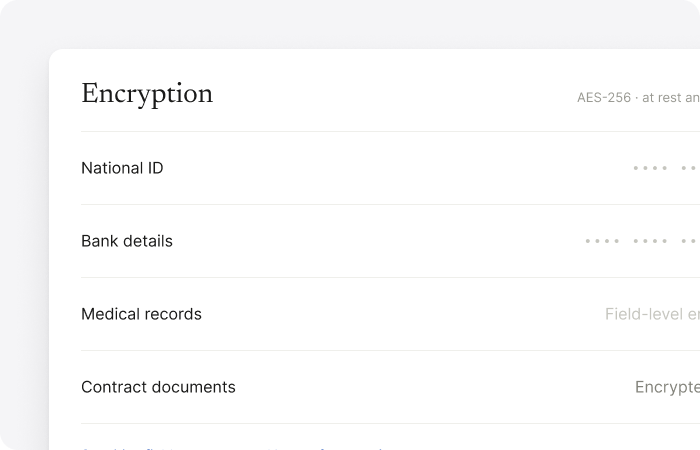
Access control decides who can reach a record through Syott. Encryption protects the data itself. All employee data is encrypted at rest and in transit with AES-256 encryption.
The most sensitive fields get more. National IDs, bank details and medical records receive additional field-level encryption, so they're protected individually rather than only as part of the database they live in.
Encryption and access control work as layers. Field-level permissions decide whether a person's role lets them see a salary or a medical record at all; encryption protects that data whether it's being stored or moving between systems.
Data residencyGDPRCCPA
Lisbon headquarters European Union
Berlin office European Union
New York office Choose a region United States
7be2 01ac f9d3a9f3 e07c 41bdc71e 0b9a f25d5d0f 9c2a b6e1
Encrypted in transit

Priya ShahEmployee record
- Full name
- Priya Shah
- National ID
- PT 2384 1192 7
- Bank details
- PT50 0035 0183
- Medical records
- Fit note, 12 March
Priya Shah
7be2 01ac f9d3
PT 2384 1192 7
a9f3 e07c 41bd
PT50 0035 0183
c71e 0b9a f25d
Fit note, 12 March
5d0f 9c2a b6e1
Marco
Your data
Export Request deletion
marco-data.zip2.4 MB
Deletion request received
Export
marco-data.zip
Request deletion
Audit trailImmutable
-
Amara Reyes
Viewed Bank details
Lisbon, PT
-
Tom Lang
Edited Home address
Berlin, DE
-
Ana Moreira
Exported Payslips
Porto, PT
-
J. Okonkwo
Viewed Medical records
London, UK
-
 Lena
Viewed National ID
Lisbon, PT
-
Nils Berg
Exported Payslips
Oslo, NO
Entries can't be edited or deleted
Retention policies
Candidate CVsDelete after 6 months
cv-jonas-weber.pdfDeleted
Employment contractsArchive for 7 years
contract-r-lopes.pdfArchived
Where data lives, and who it belongs to
Data protection law gives both companies and individuals rights and obligations, and the right tooling makes them part of normal work rather than a project. Syott helps you support your GDPR, CCPA and local data protection obligations.
Data residency controls let you choose where employee records are stored: by country, region or entity. A company with an office in Lisbon and another in New York, for example, can keep each entity's records in the region it chooses.
Employees have a direct role too. They can view, export and request deletion of their personal data directly from their profile. That fulfills right-of-access and right-to-erasure obligations without HR intervention, so a request doesn't become a ticket someone has to work through by hand.
Data residencyGDPRCCPA
Lisbon headquarters European Union
Berlin office European Union
New York office Choose a region United States
7be2 01ac f9d3a9f3 e07c 41bdc71e 0b9a f25d5d0f 9c2a b6e1
Encrypted in transit
Priya ShahEmployee record
- Full name
- Priya Shah
- National ID
- PT 2384 1192 7
- Bank details
- PT50 0035 0183
- Medical records
- Fit note, 12 March
Priya Shah
7be2 01ac f9d3
PT 2384 1192 7
a9f3 e07c 41bd
PT50 0035 0183
c71e 0b9a f25d
Fit note, 12 March
5d0f 9c2a b6e1
Marco
Your data
Export Request deletion
marco-data.zip2.4 MB
Deletion request received
Export
marco-data.zip
Request deletion
Audit trailImmutable
-
Amara Reyes
Viewed Bank details
Lisbon, PT
-
Tom Lang
Edited Home address
Berlin, DE
-
Ana Moreira
Exported Payslips
Porto, PT
-
J. Okonkwo
Viewed Medical records
London, UK
-
Lena
Viewed National ID
Lisbon, PT
-
Nils Berg
Exported Payslips
Oslo, NO
Entries can't be edited or deleted
Retention policies
Candidate CVsDelete after 6 months
cv-jonas-weber.pdfDeleted
Employment contractsArchive for 7 years
contract-r-lopes.pdfArchived
A complete record, kept only as long as needed
Being able to show what happened is as important as preventing what shouldn't. When someone asks who looked at a record, the answer should take a search, not an investigation. Every access, edit and export in Syott is logged in an immutable audit trail. You know exactly who viewed which record, when and from where, ready for any compliance audit or legal inquiry.
The same applies to permissions themselves. You can see exactly who has access to what, track permission changes, flag unusual access patterns and generate compliance reports in seconds.
Keeping data safe also means not keeping it longer than you need to. You can set automatic retention policies by document type: contracts archived for seven years, for example, and CVs deleted after six months. Data is purged on schedule, which reduces your liability and keeps storage lean. Policies are set once per document type, so nobody has to remember which files are due for deletion each month.
Data residencyGDPRCCPA
Lisbon headquarters European Union
Berlin office European Union
New York office Choose a region United States
7be2 01ac f9d3a9f3 e07c 41bdc71e 0b9a f25d5d0f 9c2a b6e1
Encrypted in transit
Priya ShahEmployee record
- Full name
- Priya Shah
- National ID
- PT 2384 1192 7
- Bank details
- PT50 0035 0183
- Medical records
- Fit note, 12 March
Priya Shah
7be2 01ac f9d3
PT 2384 1192 7
a9f3 e07c 41bd
PT50 0035 0183
c71e 0b9a f25d
Fit note, 12 March
5d0f 9c2a b6e1
Marco
Your data
Export Request deletion
marco-data.zip2.4 MB
Deletion request received
Export
marco-data.zip
Request deletion
Audit trailImmutable
-
Amara Reyes
Viewed Bank details
Lisbon, PT
-
Tom Lang
Edited Home address
Berlin, DE
-
Ana Moreira
Exported Payslips
Porto, PT
-
J. Okonkwo
Viewed Medical records
London, UK
-
Lena
Viewed National ID
Lisbon, PT
-
Nils Berg
Exported Payslips
Oslo, NO
Entries can't be edited or deleted
Retention policies
Candidate CVsDelete after 6 months
cv-jonas-weber.pdfDeleted
Employment contractsArchive for 7 years
contract-r-lopes.pdfArchived
Taken together, these controls follow a record through its whole life: who can see it, how it's protected, where it's stored, what its owner can do with it, who touched it, and when it's removed.
See it for yourself
Syott is privacy-first by design: these controls are part of every record, not an add-on. The best way to see how they fit your organization is with your own structure in front of you.
Book a demo to see access control, encryption and data residency set up for a company like yours, or talk to our sales team about your requirements.